Wednesday, June 8, 2016

Rambo revised opinion: 'First Blood' is actually first rate

The first time I saw Sylvester Stallone's original Rambo film First Blood, I didn't particularly love it.

The second time I thought it was very good but I couldn't get past the absurdity of certain elements of the plot -- especially the opening scenes.

But apparently the third time's the charm. Last night I got to see the 1982 action film on the big screen at a special screening at the Brooklyn Academy of Music, where the film's director -- the crotchety but charming Ted Kotcheff -- introduced it and did a Q&A afterwards.

His remarks certainly helped shed light on how thoughtful and smart this film is -- especially in comparison to the entertaining, but bloated sequels that followed.

Essentially, First Blood is very much an anti-war film, and not as right-wing as some might interpret it to be, with a very strong dramatic performance from Stallone at its center, which suggest depths he could go to as an actor that he sadly has not explored enough.

Of course, his Oscar-nominated performance in Creed has forced film snobs to at least think about taking him more seriously, but his early work -- in the first two Rocky films -- and here, suggest that he was really a dramatic actor trapped in an action star's body.

Stallone in First Blood
According to Kotcheff, it was Stallone who suggested giving the Rambo character minimal dialogue, which I had noticed on my first couple viewings, but it really struck me now.

This is a mysterious, haunted man of few words. So damaged and isolated from his service in Vietnam that he has no choice but to wander.

When he finally explodes in his famous (and unfairly maligned) final monologue it's shocking because he hasn't been able to adequately express himself previously.

The director made a very good and sad point about veterans returning from Vietnam -- they were shunned by both the left and the right. Sure, we know about soldiers being taunted and spit on by anti-war activists, but not enough is said about how right-wingers also distanced themselves from those soldiers because they were seen as "losers" who put the first official defeat on our war scoreboard.

Curiously, the villains of the first Rambo film aren't the weaselly bureaucrats who would populate the later editions -- they are law enforcement. Kotcheff casts the decidedly unsympathetic Brian Dennehy as a bullying sheriff who instantly decides to harass and antagonize Rambo simply because of the way he looks. I was particularly struck by how prominent the U.S. flags were on the uniforms of the officers while they mercilessly try to hunt down our hero.

Kotcheff said that the treatment Rambo receives and the town itself was meant to be representative of the country as a whole and the way Vietnam veterans were used and then abused. And at least in the original First Blood, that comes across.

The audience I saw it with snickered at times -- and sure, some of the film's elements are dated and melodramatic. But it is a serious film -- even a gritty one at times, where the action is taut and riveting. Stallone is leaner here than he would be in subsequent films and therefore more vulnerable.

It's worth a second (or in my case, third) look -- before Rambo literally became a cartoon character -- he was a powerful surrogate for a whole population on men who deserved better.

Sunday, June 5, 2016

'When We Were Kings' and 'Facing Ali': Honoring 'The Greatest'

Like so many Americans I am still reeling from the loss of Muhammad Ali. Not only was he arguably the most beloved athlete of is time but he was also one of the most photogenic, which is why -- besides his inspiring life story -- he was always compelling on screen.

It's hard to capture his greatest in a narrative film. The Will Smith vehicle, while reasonably well made, felt scattered. It tried to cover too much ground and never had much of a center. Smith did a terrific Ali impression, but didn't really delve deeper to reveal his inner life.

If you're looking to find the definitive cinematic takes on Ali you can do no worse than two brilliant documentaries.

One is the well known Oscar winner, which MSNBC has wisely been rebroadcasting this past weekend: 1996's When We Were Kings.

The film is largely focused on Ali's seminal 1974 fight against George Foreman, also known as the Rumble in the Jungle, but it's also a terrific overview of Ali's entire historic career up until that point.

The hook of that film is its remarkable found footage, culled from hours upon hours of on-the-scene coverage in Zaire, where the fight took place. This includes infectious concert performances from the likes of James Brown and B.B. King, as well as candid interviews with the then-former champ (Ali) and the reigning one (a terse George Foreman).

The Rumble in the Jungle
That film is a great primer for Ali fans and those who are still learning about the legend. And an ideal companion piece is 2009's Facing Ali, a documentary that tells the fighter's story from the perspective of the men who took him on in the ring.

These are compelling and in some cases broken men, who are incredibly incisive about Ali's skills and persona. This is no hagiography, but it both reaffirms Ali's greatness while elevating the unique brutality and beauty of the sport of boxing in under two hours.

Both films are filled with illustrious and colorful talking heads but the real star of both features if of course Ali himself. His distinct speech pattern, his humor, his warmth light up the screen. Even when he occasionally seems petulant or insensitive, it's impossible not to be charmed by him at every turn.

At the end of When We Were Kings, you see him at his highest point, basking in the glow of what would be the biggest upset of his career. With Facing Ali, you get a glimpse of a run in the ring that last far too long, and possibly cost him his voice and his body, if not his mind.

I've already shared my personal thoughts on why I believe Ali was truly the "greatest" athlete of his time (and one of the great men, too). He was the living personification of all that is exciting and inspirational about the American dream. If you don't believe me or want to see for yourself, watch these two films -- they deliver a knockout punch.

Saturday, June 4, 2016

'Under the Cherry Moon' vs.'Raw': Vanity projects go wrong/right

Yesterday I watched two iconic 1980s films back-to-back that on the surface have very little in common but actually share some fascinating DNA. The first, 1986's Prince vehicle Under the Cherry Moon was an unmitigated disaster -- despite the classic soundtrack that accompanied it. While Eddie Murphy Raw remains one of the comic's most popular, quotable hits.
I am so pre-disposed to love anything Prince did, that after he died I decided to revisit his ill-fated follow-up to Purple Rain. I'd sat through it once before and hated it, but I had hoped that perhaps a second viewing would reveal some of its charms, or at the very least redeem it as an imperfect curio.

Despite my undying adoration for Prince, it's still a terrible film. It looks terrific, the black and white cinematography is very flattering to Prince and the rest of the cast, and he and Jerome Benton (who plays his long suffering sidekick here) do have a genuine chemistry, but otherwise the movie offers very little in terms of entertainment or story.

What little plot there is consists of Prince mugging and frolicking around as a gigolo who specializes in seducing rich women. He falls for a particularly snooty one, played by Kristin Scott-Thomas, which provokes the ire of her evil, rich father-in-law, who, in a pretty inexplicable twist, has the singer gunned down in the final act.

I finally think I figured out what is fundamentally wrong with this movie -- besides the fact that Prince barely performs any music in it -- and I think it's that he's playing a role that would have been much better suited for his Purple Rain nemesis Morris Day.

Day had great comic timing and a kind of goofball sex appeal. Watching him prance around this vaguely surreal setting with Benton at his side would have been a lot of fun, but comedy doesn't fit Prince quite like a glove (even though privately he was known to be very funny). Perhaps he was jealous of the praise Day received for his performance in Purple Rain, compared to the mixed reviews he received himself, and, always competitive, wanted to top him.

Needless to say he doesn't. And his tendency to act petulant and sexist opposite women -- which was somewhat justified in Purple Rain by a horrific life at home that gave his character gravitas -- is vain and self indulgent here.

Eddie Murphy is no less vain or misogynistic in Raw, but he is also incredibly funny -- albeit in a guilty pleasure sort of way -- which is why his concert film is the rousing success Prince's film isn't.

Raw was essentially a victory lap for him. After a string of huge box office hits (including 48 Hrs., Trading Places and Beverly Hills Cop), Murphy was the biggest movie star on the planet and so he could release an old-fashioned stand-up comedy film and have it outgross many traditional blockbusters.
Eddie Murphy in Raw

He could parade on stage in a skintight purple leather jumpsuit and not be questioned over it. He could boast about his own sexual prowess and get nothing but roars of approval from women in the crowd. There's something infectious about his egoism at this period. It's not politically correct but it's undeniably charismatic.

Like in all of Murphy's stand-up you have to put the problematic material in the context of its time. It's homophobic, virulently anti-women to the point of paranoid, and hostile to the culture of Africa that he would more lovingly send up in the following year's Coming to America.

But it's also chockfull of Murphy's unique talent. His ability to take on other personas is really what set him apart from Richard Pryor and other A-list comics of the day. He effortlessly slips into the voice and body language of a stereotypical Italian who is on a macho high after seeing a Rocky movie and he personifies members of his own family (both male and female) as they argue around the dinner table.

Too many of Murphy's movies have dialed back what made him great, but with no one else to share the stage and no convoluted plot to drag him down, in Raw he's given full reign to explore his own eccentricities and even the offensive concepts offer an intriguing window into Murphy's own psyche.

In 1987, he was on top of the world and probably had no reason to anticipate the rocky ups and downs his career would take in the decades that followed. Meanwhile, Prince would make a couple more films (the highly regarded but little seen concert film Sign O' the Times, and the barely watchable Graffiti Bridge), but seemed to concede eventually that he was no movie star.

Murphy has remained a viable, and unsung draw for decades but has recently disappeared from movie screens and also public view. His appearance at the SNL40 special was a disappointment, he didn't tell jokes or participate in sketches, he just looked uncomfortable and that made me sad.

I still think he has greatness in him, both as an actor and a comedian, and hopefully we'll get to see it before he too is gone too soon.

Friday, June 3, 2016

'Bachelor Party' is mostly an exercise in bad taste

Some 1980s movies are both perfect artifacts of their time and pop culture masterpieces that still stand the test of time -- I'm thinking Ghostbusters or E.T. or the first three Indiana Jones movies -- and then there are films like Bachelor Party, which you hope will be an infectious romp, but wind up being an unmitigated bummer.

I had never seen the movie and never felt a particularly strong urge to, but since I took the day off (today's my birthday) and I'm hosting my own bachelor party tomorrow, I figured I'd give it a whirl -- boy, was it bad.

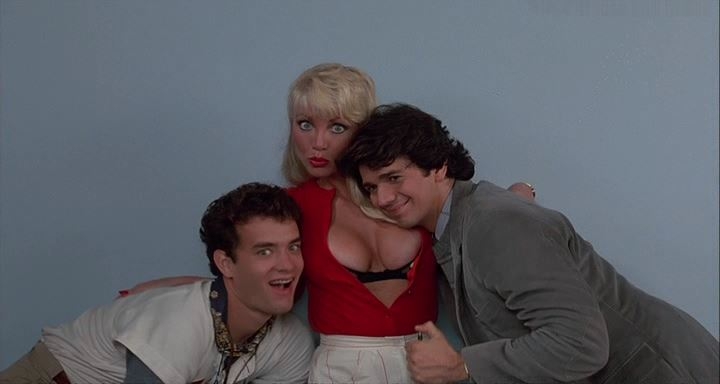
I think of all the performers in the movie, Tom Hanks walks away more or less unscathed.

I am sure this is not a film he'd want to be fondly remembered for when he accepts his inevitable Cecile B. DeMille award though. After seeing his very amusing cameo in the debut episode of Maya & Marty, I did think I'd like to see him do a broad comedy again.

People forget that he was largely known as a comic actor until the mid-90s when he became a bonafide phenomenon; in fact he was often the third choice for roles after Bill Murray or Chevy Chase passed.

Not Tom Hanks' best moment
Here he plays a pretty moronic character who clearly is not too enthused about getting married, but we're supposed to root for him because he resists sleeping with other women on the night of his bachelor party. There's nothing here that anticipates the future two-time Oscar winner's true talent.

What is here is one of the most unfunny, misogynistic and tasteless movies I've seen in a while -- unless a donkey overdosing from cocaine is your idea of a laugh riot. There's a little bit of T&A if that is enough to sustain you. And there was one sequence that did mildly amuse me -- a fight scene at the end in a movie theater showing a 3-D film -- where the action syncs with what's taking place on screen. The rest is basically a lot of unfortunate racial humor and anti-women hostility.

This film pretty much captures the opposite of what I would want out of a bachelor party. A lot of bitter, angry guys who either resent being married or ridicule their friend for getting married. They surround themselves with a bevy of prostitutes, none of whom get an ounce of character development, who we're led to believe they're all sleeping with for the duration of the evening.
The Pimp

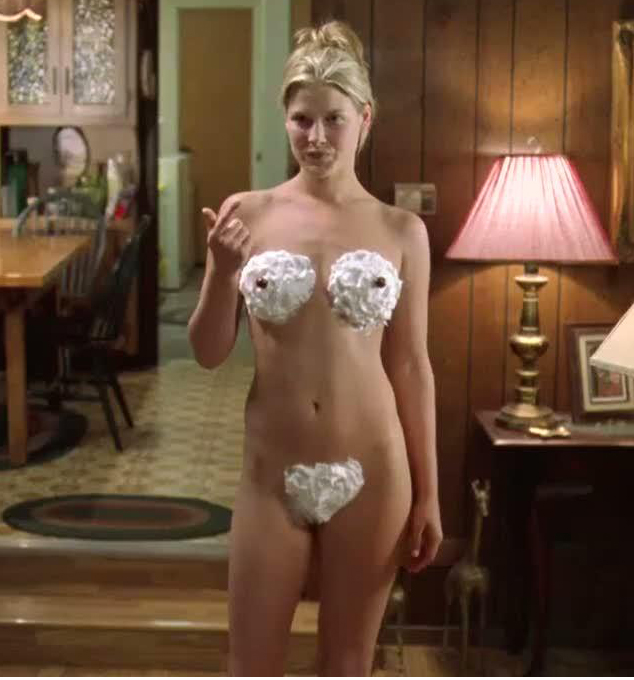
Later in the film another woman shows up -- who apparently has held a longtime crush on Hanks' character -- she disrobes and offers herself to him, and when he turns her down she basically becomes an afterthought who gets utilized in a prank that gets played on the "bad guy."

Speaking of the bad guy -- he's the cliched, atrocious, WASPy blonde guy that was a staple in the '80s. He is after Hanks' fiancee (video vixen Tawny Kitaen!) and literally offers to swap his new Porsche for her. But in reality he's no more repugnant that our heroes, one whom is featured in a horribly dated, transphobic scene that is demeaning to everyone involved.

And then there's the "pimp." The filmmakers probably thought they were doing people of color a solid, by not casting a stereotypical black actor, but they go with a goofy, offensive Indian guy instead.

I am all for politically incorrect -- if it's funny. But despite some aggressive efforts to create a raucous atmosphere, the whole movie feels so hollow. There's not really much of a story per se. Hanks' horndog friends seem to be fully supportive of the notion that he should cheat on his fiancee, meanwhile she and her dimwitted friends try to have a wild night of there own -- which somehow climaxes when them dressing up as prostitutes too. Yes, besides a nun who appears early in the film, every woman who appears in this film is either a hooker or dresses like one at some point.

The tone of the movie is set from almost the very first scene, where Hanks' sidekick, the 80's-era stud Adrian Zmed, photographers a buxom woman and her son at a department store. The camera zooms in on her cleavage and then Zmed takes great pains to marginalize the child so he can ogle the woman. It's not funny, it's not interesting, it's just there.

Needless to say, my real life bachelor party should be a more gratifying experience.

Sunday, May 29, 2016

'Never Seen It' - Episode 3 - 'Varsity Blues' has one of us seeing red

Ali Larter
And we're back! Liz Rosado and I are at it again with another installment of our earnest attempt at podcasting -- "Never Seen It."

For our first time listeners, Liz and I pick a relatively well-known movie which neither of us have seen before, watch it and then share our impressions with each other for the first time on tape.

First we did the John Hughes classic Some Kind of Wonderful, then we watched Vin Diesel's XXX. For this episode, we revisited the 1999 football drama Varsity Blues.

This is our most epic episode yet, listen to the audio below and find out what we thought out this Clinton-era 'classic.'


Neither of us sound southern.

Thursday, May 26, 2016

'The Lobster' defies definition, and I'm not sure if that's a good thing

Every once and a while I see a film I can't quite figure out that defies explanation. The Lobster is one of those films.

It's an uneasy mix of some truly unsettling scenes, mixed with some uncomfortably funny ones.

 A lot of critics are lavishing it with praise and while I do applaud its originality, I'm not sure I'm totally on board with it.

It reminds me to some degree of Charlie Kaufman's Synecdoche, New York, another low key black comedy with some brilliant ideas that went off the rails for me.

I think I could enjoy this movie more after repeat viewings -- I can't imagine it will find much of a mainstream audience but I do think it could become a midnight movie staple.

The first half is fantastic. Taking place in some kind of alternative universe, an against-type Colin Farrell plays a socially awkward schlub who checks into (or is forced to enter? it's never clear) a creepy hotel where you have to meet and marry someone or risk turning into an animal (albeit of your choice) after just 45 days.

Comparisons to Kubrick are apt -- from the cold, but beautifully-composed shots to the intially detached narrator who appears to be ironically commenting on the action. Characters almost all speak in a robotic, deadpan way -- which may grow grating for some viewers -- but it at least reflects a consistency of vision.

Colin Farrell and Rachel Weisz in The Lobster
At about the midway point though the movie starts to feel a little rudderless (and overlong). It never becomes boring but I feel like I lost the thread of what this film was trying to say. If its goal was to keep viewers off-kilter, it achieved that but its jarring bursts of violence and at times horror-like score felt, on occasion, like weirdness for the sake of weirdness.

Farrell deserves some credit for stretching, and he has some very impressive comedic scenes -- but I also couldn't help but feel like he was an odd choice. The supporting cast fares much better for me on first viewing, especially John C. Reilly -- who is much more adept at the timing this kind of film requires -- and Olivia Colman, who will be familiar to fans of the great British sitcom Peep Show, gives a scene-stealing performance in what I would describe as the "Tilda Swinton role."

It's such a hard thing for me to gauge, that line between ambition and self-indulgence. I am always more receptive to a movie that swings for the fences and misses than a movie that relies on tired tropes and panders to its audience. And The Lobster definitely doesn't do anything like the latter.

I was expecting a movie on the same wavelength as Her, and this movie manages to be far less accessible and charming than that movie was. The tone is both monotonous and caustic. There are times when it felt like I was watching an inside joke that I wasn't in on. And yet I couldn't help but discuss the film after it ended (speaking of which, perhaps the one thing that is predictable about the movie is that it ends in a Sopranos-like offbeat note).

This film creates a whole world of its own that probably raises more questions than answers -- it would make for an intriguing TV series or a novel. As a film, I feel like it can't be easily dismissed, but it also isn't easily digested.

Wednesday, May 18, 2016

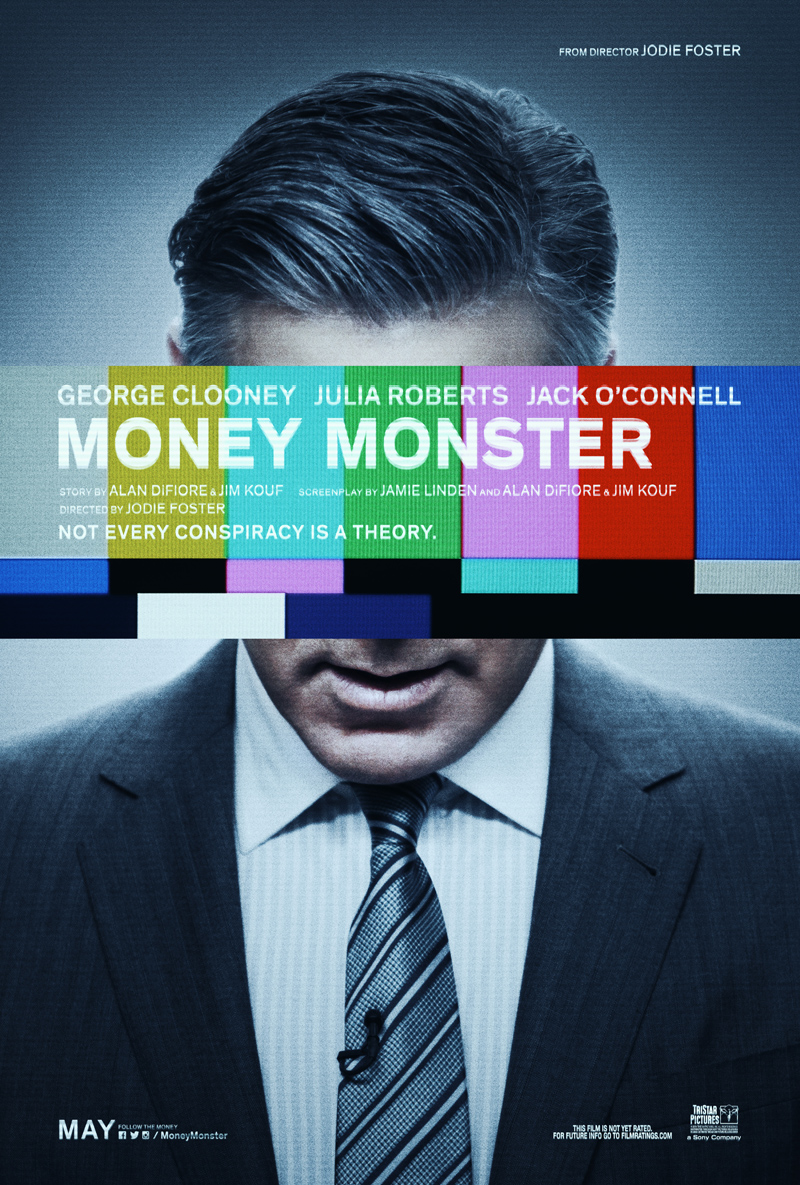
'Money Monster' is not a total misfire, just a missed opportunity

The times seem to be ripe for a politically-charged thriller with anti-Wall Street overtones, but the new film Money Monster really isn't that kind of movie.

It's a perfectly watchable, competent movie with George Clooney delivering yet another one his charismatic star turns, the kind he can probably do in his sleep at this point. It's not a bad movie, but it could have been a great one, which is why it's maddening on some levels.

The premise is strong. A shallow, egotistical Jim Cramer-style host of a financial advice show (played by Clooney) gets held hostage by a viewer he unintentionally led astray.

Now, if only the antagonist had been truly formidable or actress Jodie Foster's direction been a little more imaginative, and this film could have been a classic.

Foster as an actress has a distinct rhythm and power, but her directorial work here has no voice or style. So the heavy lifting mostly falls on Clooney, who is as game as ever in the lead role (Julia Roberts is fine in a mostly thankless second lead). After walking out of this movie I came to believe that the film's biggest flaw/mistake is the casting of the relatively unknown Jack O'Connell as his would-be kidnapper.

It's not that O'Connell gives a terrible performance. He does a decent job with a pretty underwritten role. But this part really cried out for another star of Clooney's caliber. It would have been very cool to see him match wits with Denzel Washington or maybe even a whacked-out Jake Gyllenhaal.
O'Connell and Clooney

This even could have been a case where casting someone to type would have made a lot more sense cinematically.

Put someone like Michael Shannon in the role of the enraged, aggrieved interloper and I've already got goosebumps. It's a part that could have used a little over-the-top intensity.

O'Connell is too innocent and cherubic to ever really create a sense of danger. I never really saw him as a physical threat to Clooney, and so scenes that are meant to be crackling with tension never really generate too much excitement. Things start to kick into higher gear by the film's third act, but it feels almost like too little too late.

Clooney has been going through a bit of slump lately. Both The Monuments Men and Tomorrowland earned mixed reviews and were considered somewhat disappointing at the box office, and although Hail, Caesar was a critical hit, audiences avoided it in droves.

Money Monster will hardly go down as one of his most memorable movies, but I hope he doesn't stop making this kind of adult, non-special-effects-driven film any time soon. He remains one of our few remaining classic movie stars, who almost always delivers smart entertainment.

And for my money, that's always worth the price of a ticket.