Saturday, April 12, 2014

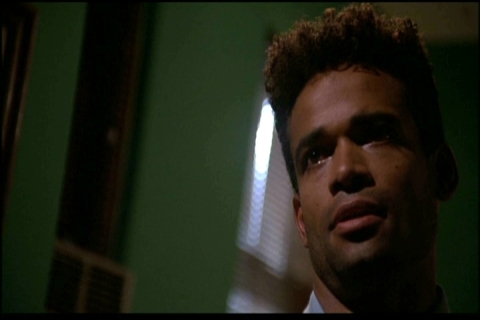
'New Jack City': The best blaxploitation B-movie of the 90s

Wesley Snipes in New Jack City
New Jack City is a ridiculous movie -- in the best way. It's heavy-handed anti-drug message could only come out of the late 80s and early '90s. The "acting" of Ice-T is suspect at best and I don't know what the hell is going on with Mario Van Peebles' hair.

And yet this is one of the most quotable and well-liked "black" movies of its era, or any era for that matter.

It's essentially a blaxploitation movie that came about two decades after the genre's heyday. And it features the best, most charismatic role of Wesley Snipes' career in the legendary gangster villain Nino Brown.

His character is second only to Al Pacino's Scarface in hip-hop lore and it's easy to see why. He has no redeeming qualities, virtually no humanity, just effortless cool.

It's interesting to revisit this film now because we are in the midst of another so-called black movie renaissance, albeit one with more classy fare like 12 Years a Slave and Fruitvale Station.

The last time so many African-American-themed films dominated the landscape it was the early '90s, which New Jack City is a perfect time capsule of. And I'm not just talking about the Raiders' swag Ice-T wears. The movie is ambitious (perhaps to a fault) and it was also just one flavor of many. Black audiences could laugh at House Party, be moved by Boyz n the Hood and be excited by an updated cops and robbers flick like New Jack City.

By updated -- I mean the inclusion of subplots like Chris Rock's Pookie (a rare dramatic performance) trying to kick drugs, which looks hokey now, but was crucial to the film's appeal back in 1991. Sadly, and probably to the chagrin of Van Peebles (who was also the film's director), the movie's positive message is almost entirely forgotten some 23 years later.

It's Nino Brown's swagger and bravado that has stood the test of time. Lil Wayne namecheck's his drug den on his Tha Carter albums and young brothers who have never even seen the movie quote lines like "Sit your five dollar ass down before I make change."

Scarface, one of my all time favorite movies, was of course anti-drugs and crime too. Pacino's character is killed in an especially gruesome, prolonged way and yet, no one cares about that.

And the politics in New Jack City are far less subtle than anything in Scarface. Some scenes read like people reciting a New York Times op-ed. And the power of those moments have definitely been diluted.

Yet if you look past the specifying and "message" of the movie and enjoy it for pure entertainment value, it's a blast.

You've got the awesome soundtrack, cameos from folks like Fab 5 Freddy and Keith Sweat, plus that flashy party style of early-90s fashion -- a style that I definitely remember vividly from my childhood. Ironically some of the outfits in this movie could be perfect for a hipster trying to make a statement.

I wouldn't exactly call it a smart movie but it does have one element that stands out for its prescience. Nino Brown projects Pacino's Scarface in his crib and he even quotes him. This film appeared to capture the real gangster emulating fake gangsters aesthetic which is both very real and insidious.

It you're my age (31) or older and from the Tri-State area, this is a perfect, occasionally campy, trip down memory lane.

Friday, April 11, 2014

'Under the Skin' may not be for everyone but it's unforgettable

Under the Skin
All I can say is wow.

It's too early to say if Under the Skin is one of the best films of the year -- but it is definitely going to go down as one of the most original movies of 2014.

I was floored by this film and yet I imagine few will be -- at least not until time and distance give it the reception it deserves. I'm still unpacking my experience with it, so forgive me if I'm being vague.

This was the most aggressively inaccessible movie I've seen since Only God Forgives, another consciously stylish and challenging movie. albeit one that critics reviled.

I loved that film but only because I dug what its director Nicolas Winding Refn was doing, even if it was more than a little indulgent. Gratefully, most critics seem to be on board with Under the Skin and hip to its audacity but I fear audiences may never be.

What most people are aware of when it comes to Under the Skin is that some are comparing it to the work of Stanley Kubrick and that its sexy star, Scarlett Johansson, gets naked in it.

I will address both points briefly.

I am a huge fan of Kubrick, but I think it does a disservice to this film's director, Jonathan Glazer, to simply dismiss his work as an homage to the late genius. There is a similar willingness to present his narrative at an emotional distance, to create a sense of dread with silence and music but this is a work of art that stands on its own.

Scarlett Johansson in Under the Skin
As far as the nudity is concerned I will say that it is tasteful and wholly necessary to the narrative but will be totally unsatisfying for audiences seeking this film out for prurient purposes.

This is intellectual filmmaking at its finest and its arguably thin plot invites all sorts of analysis and re-examination. It's a movie I wasn't sure I liked while I was watching it and came to realize I totally loved while discussing it afterwords.

I suppose it belongs under the category of sci-fi, in that it deals with beings who appear not to be of this world.

And it does share some DNA will less accessible works like Nicolas Roeg's The Man Who Fell to Earth. Johannson gives a startling performance not unlike David Bowie's in that seminal film. She is slightly off and yet totally engaging.

It's hard to recommend this film, especially to people who aren't hardcore film fanatics, because so many people want instant gratification from a story that spells itself out for you or at least gives you enough backstory that you're not totally thrown to the wolves.

This movies does you no such favors. It moves at pace that is beyond glacial (even though it clocks in at less than 2 hours). Much of it is wordless. And yet it is unbelievably tense and unsettling from the very first frame.

I will stop here and say that this a movie I only hope people will continue to talk about by the end of the year. It has something to say about gender, about sexuality and human nature. And it'd be a shame to see that lost in the cinematic shuffle.

They don't make movies like this anymore. And pretty soon -- they never will.

'Mean Streets': What's a 'mook'? I guess it's another masterpiece

"In my mind it's not really a film -- it's a declaration of who I am and how I was living' -- Martin Scorsese.

Mean Streets is a movie that has earned legendary status because its the first film that really established some of Scorsese's trademark aesthetics and it was the first truly unflinching look at a certain crude side of urban culture to ever be on the big screen.

Looking at the movie now, it's a messy and somewhat not fully formed vision. It lacks the assuredness of some of Scorsese's latter pictures. And yet it has an undeniable power. It wears its religious symbolism on its sleeve but it works because it's such a deeply personal film.

To watch Mean Streets today is to marvel at the fact that for a brief period in the 1970s movies like it were even made.

The plot is meandering to say the least. It mostly revolves around the relationship between Charlie (Harvey Keitel) a deeply religious and conflicted character, which is based largely on Scorsese himself, and Johnny Boy (Robert De Niro), a thoroughly unreliable but undeniably likable troublemaker who is constantly in debt to virtually everyone he knows.

One of the problems I've always had with the movie is that I never understood why Charlie is so loyal to Johnny Boy. De Niro's character is never particularly grateful to Keitel's for all the risks he takes on his behalf and by the end of the picture it's so clear that Johnny Boy is dragging Charlie down, possibly to his own demise that I struggle with understanding Charlie's motivations.

But I think part of that is because I am an atheist and Charlie, despite his myriad of sins, is a devout Catholic. He is riddled with guilt and feels a great sense of duty to family and friends. Keitel is excellent in this role. De Niro has the showy part -- and he practically rips through the screen with his mad energy, but Keitel really grounds the film, which like The Wolf of Wall Street has a tendency to to go off on tangents that are still in keeping with the theme.
Martin Scorsese

For instance, one of my favorites, and perhaps because I am an African-American, the most memorable -- is Keitel's brief infatuation with a gorgeous black go-go dancer.

In a voiceover, Keitel reveals his racial insecurities. He wants to date her but he fears the reaction of his Italian peers to his dating a black girl.

The fact that this 1973 film even delves into this interracial dating ambiguity feels revolutionary. It's apparent later in the movie that Charlie's friends are deeply racist.

In an unpleasant scene one character mocks another by telling him he once saw his girlfriend kissing a black man under a bridge. Charlie eventually picks up the black girl but then stands her up -- he can't go through with the date.

In the very last scene of the film -- which I won't spoil -- but let's just say it's dark and tragic, there is a quick shot of the black girl waiting on Keitel's character to show up. It's a quick flashback, and I presume an image in Charlie's mind. And I never noticed it really before. I think that shot is meant to suggest a choice that he now regrets.

Had Charlie ignored conventions and gone on that date maybe his life could have taken another path -- but instead he chose to keep close to the doomed Johnny Boy and his volatile, epileptic cousin (who Charlie is dating). And at that moment I connected with the film, cause I understand Charlie's regret of missed opportunities and his embarrassing bout of cowardice.

Ironically Scorsese was initially encouraged to make the film with an all black-cast to capitalize on the burgeoning blaxploitation genre. Go figure.

Wednesday, April 9, 2014

'The Searchers' shows off the strength of the John Wayne persona

Based on what little I know about John Wayne -- I don't like him. He appears to have been deeply racially prejudiced and his politics were beyond reactionary. But he was one hell of a movie star.

Popular enough to get his own nickname ("The Duke"), Wayne is one of the most iconic Hollywood actors of all time. And after revisiting his seminal film The Searchers, it's easy to see why.

The film, a favorite among 60s generation filmmakers like Scorsese and Spielberg, has grown in stature with each ensuing decade and is now often high up on lists of the greatest movies ever made.

It is a startlingly good western, one which is more rewarding with each viewing because there is so much fascinating subtext beneath its surface.

The story is an epic one. Comanche Indians (a.k.a.  Native Americans) kidnap a young white girl and Wayne (as the complex Ethan Edwards) goes on a years long search (accompanied by a "half-breed" named Marty, played by Jeffrey Hunter) to retrieve her.

Wayne's character is an unrepentant racist with an all-encompassing hatred of Indians and yet he is incredibly well-versed in their culture -- he speaks their language, knows their customs and eventually even practices them (in a chilling scene towards the finale, Edwards takes a scalp of his own). This is just the first of many interesting contradictions in the character.

The heart of the film is Edwards' contentious relationship with Marty, who he routinely disrespects and abuses because he is 1/8th Cherokee. Yet, there is a clearly a fatherly affection there too. Again, this movie has layers.
John Wayne in The Searchers

There are some conventional aspects of the movie that grate (like some of its attempts at broad comedy) and while in some ways its director, John Ford, was attempting to humanize the Indians he had vilified in so many past films, he still comes up a little short (although he is unflinching in showing a massacre of natives by the U.S. cavalry).

That said, the film is worth watching if nothing else for Wayne's astonishing performance. I love seeing an actor play against type and here we have the most established of American heroes played a deeply disturbed and vindictive individual.

It's no surprise that Scorsese is attracted to this character and film, since he is a master of making his audience identify with people that are unsavory.

I love westerns much in the same way I enjoy gangster films -- they take place in a world so far removed from my own  that watching them is a true act of pure escapism. They almost always have huge issues at stake -- life and death -- plus heavy doses of violence and sexual energy.

It's in these genres that older films, which were subjected to more strident censorship, were freer to explore controversial contemporary themes. Hence you get a western set in 1880s Texas which is as much about the racial strife of the 1950s as anything else.

Having seen The Searchers several times I still find myself unpacking its "happy" ending. It seems to easy too me and I suspect there are more complex conclusions to draw from it.

Nevertheless I love a film that gives me something to chew on and this one definitely does.

Sunday, April 6, 2014

My top 10 favorite superhero movies of all time

Michael Keaton as Batman
I saw Captain America: The Winter Soldier last night. It was pretty good but also a little overrated.

The early reviews suggested the film shared the DNA of paranoid thrillers of the '70s like Three Days of the Condor, but for me it was just the best Avengers movie to date without Iron Man in it.

It was a fun movie, don't get me wrong. It had some nice twists and appealing supporting work from the likes of Robert Redford and Samuel L. Jackson, but it was fatally flawed because the Captain America character isn't. Let me explain...

I've got nothing against Chris Evans. He's perfectly likable in the lead role. But the best superheroes have easily identifiable flaws which make them more relatable and compelling. Batman is pretty much certifiably insane. Iron Man drinks too much and is an egomaniac. Even Superman broke the one rule he was sent to Earth with -- he was required not to change the course of human history, which of course he did.

But Captain America (a.k.a. Steve Rogers) is just a totally good guy, which makes his fate and his story arc pretty boiler plate. The movie suffers from over-length and a few climaxes too many -- but I would recommend it since it actually has some ideas, which is more than I could say for the average Thor movie.

Yet, despite a lot of critical raves, it wouldn't make my top 10 superhero movies list.

I am actually a pretty big fan of the genre. I loved comic books growing up (although I'm no fanatic) and I think when these films work they really tap into the magic of film and its stylish and technical possibilities. Here are my 10 favorite superhero movies to date:

10) The Incredibles (2004): One of the all-time best Pixar creations is secretly an excellent action film disguised as a cuddly kids' fantasy. This visually dynamic and original film really tapped into the appeal and burden of being superhuman. The film's director, Brad Bird, made a seamless transition to real life action films with Mission Impossible: Ghost Protocol.

Christopher Reeve as Superman
9) The Amazing Spider-Man (2012): The Tobey Maguire films don't really hold up all that well under scrutiny. He played Peter Parker as a socially inept geek with very little charisma. I love how Andrew Garfield plays him more in the vein of a James Dean punk. Also, special effects have finally caught up with filmmakers ambitions and so this version of the origin story felt less like a live action cartoon. Excited for part 2.

8) Superman II (1981):  While the production was troubled, it doesn't show on screen. Superman gives up his powers to have sex with Lois Lane. Terrence Stamp delivers his unforgettable "Kneel before Zod" line and the best Superman of all time, Christopher Reeve, gets to take this iconic character to new, impressive heights. I also enjoy Superman III and IV for camp value.

7) Batman Returns (1992): The darker of Tim Burton's Batman films is incredibly satisfying. It's a gothic visual feast, featuring Michelle Pfeiffer as arguably the best Catwoman of all time. Danny DeVito creates a truly grotesque version of the Penguin. And Michael Keaton maintains his ownership of the Caped Crusader role. I will never forget seeing this film on the big screen. It was scary but I couldn't take my eyes off it.

6) Iron Man (2008): I actually really enjoy all the Iron Man films, but the first one is still the best. Hollywood took a real chance on Robert Downey, Jr. and director Jon Favreau and the results were iconic. Downey became a huge movie star playing Tony Stark/Iron Man as a truly charismatic and original hero as a whip smart brainiac with soul. He, and the entire cast, really elevated the Marvel brand to a new level.

5) The Avengers (2012): This movie brilliantly brought together Iron Man, Thor, Captain America, The Hulk and others in an Ocean's Eleven-style romp. A summer movie that really delivered in every single way -- especially with Mark Ruffalo's note-perfect take on the Hulk. It succeeded largely thanks to its genuine sense of humor and some expertly staged action set pieces which feel like a comic book playing out on the screen.

4) The Dark Knight Rises (2012): The second best entry in the Christopher Nolan series of Batman films was a fitting finale to the one of the greatest action trilogies of all time. Tom Hardy's Bane was unforgettable and Anne Hathaway more than held her own as Catwoman. But for me it was Michael Caine's work in this one that was the stand out. This grand epic took the scale of these kinds of films to the stratosphere.

3) Superman: The Movie (1978): The blueprint for every successful superhero adaptation starts with the Christopher Reeve original. Richard Donner and company assembled top-notch actors -- Marlon Brando, Gene Hackman and the classically trained Reeve (just to name a few) and took its subject matter totally seriously, which in turn made the audience respect what was up there on the screen. Is it corny and hokey at points? Sure. But it's big bold Hollywood entertainment of the first order.

2) The Dark Knight (2008): Like the first Batman film in 1989, this superhero movie changed everything. It was a commentary on the socio-political climate of the Bush years, it was a brilliant exploration of the nature of evil and heroism and it gave us one of the all time great performances -- Heath Ledger as the Joker. It should have been nominated for best picture and won. It was that good. Endlessly watchable and entertaining -- it's one of my favorite films of all time.

1) Batman (1989): This is my favorite movie of all time for personal reasons that are almost too numerous to mention. It's hard for me to describe this movie without saying favorite this and favorite that with every other sentence. So I will just credit it for being the film that established what great modern superhero films could and should be. The look, music, script and acting are all high water marks for the genre and every great comic book movie owes a debt to Tim Burton's classic Caped Crusader film.

Saturday, April 5, 2014

Woody Allen's inspiring later career winning streak

Cate Blanchett in Blue Jasmine
Blue Jasmine is just the latest late career masterpiece from Woody Allen. Not only does Cate Blanchett give a stunning performance (for which she won a richly deserved Oscar) but the film is a testament to how fresh and witty Allen's mind still is.

Sadly, his genuine talent has been overshadowed as of late by debate over his undeniably messy personal life. I won't engage in that here. I will simply admit that I am a huge fan of his and I've found his work in the last decade or so to be an inspiration. When I watch movies like the incredibly sexy Vicky Christina Barcelona, I am shocked that they've been written by a nearly 80-year-old who appears to live a sheltered lifestyle that has barely evolved in over forty years.

His work in the 1970s really established him as a filmmaking force. Annie Hall and Manhattan remain two of my favorite films of the decade. The '80s were also a fertile period for Allen, my personal all-time favorite film of his, Crimes and Misdemeanors, came out during that era, as did classics like The Purple Rose of Cairo and Hannah and Her Sisters.

However, for me, his '90s output was mostly a waste. There were occasional bright spots, but for the most part he was treading water and repeating himself with diminishing results.

Woody Allen and one of his muses
So like so many film buffs I was stunned by the left curve which was 2005's Match Point. A real thriller with some unapologetically dark undertones, that movie was a real change of pace (and scenery, the film was set in the UK) for Allen. I loved Vicky Christina Barcelona even more. And then the utterly charming Midnight In Paris arrived and became the biggest hit of his career.

Of course when you release one new film every year some of them are going to miss big (Scoop, anyone?), but that's understandable. Still, after Blue Jasmine, the case could be made that this may be the best period of Allen's career.

I have no idea how the man does it. I watched an extensive documentary about his process (complete with typing out his scripts on the same old-fashioned typewriter) and still don't understand how he can remain so timely and relevant well into old age.

And he's still hilarious after all these years. I understand that his humor isn't for everyone. And there are people who, for completely respectable reasons, can't get past his off-screen problems. But for me, he is now, and always will remain, a genius.

As a filmmaker I think he is incredibly underrated. Like Tarantino (who is a big fan of Allen's), his writing is his selling point, but he's also proven to be quite adept at his staging and editing as well.

If you can tune out the drama surrounding him and look at the film Blue Jasmine on its own terms, it's an incredibly smart, funny and ultimately devastating indictment of classism in modern America, complete with a terrific supporting performance from Andrew 'Dice' Clay of all people.

Who knows what more Allen has to say after 45 years of making movies -- I have no idea, but I'm curious to find out.

Thursday, April 3, 2014

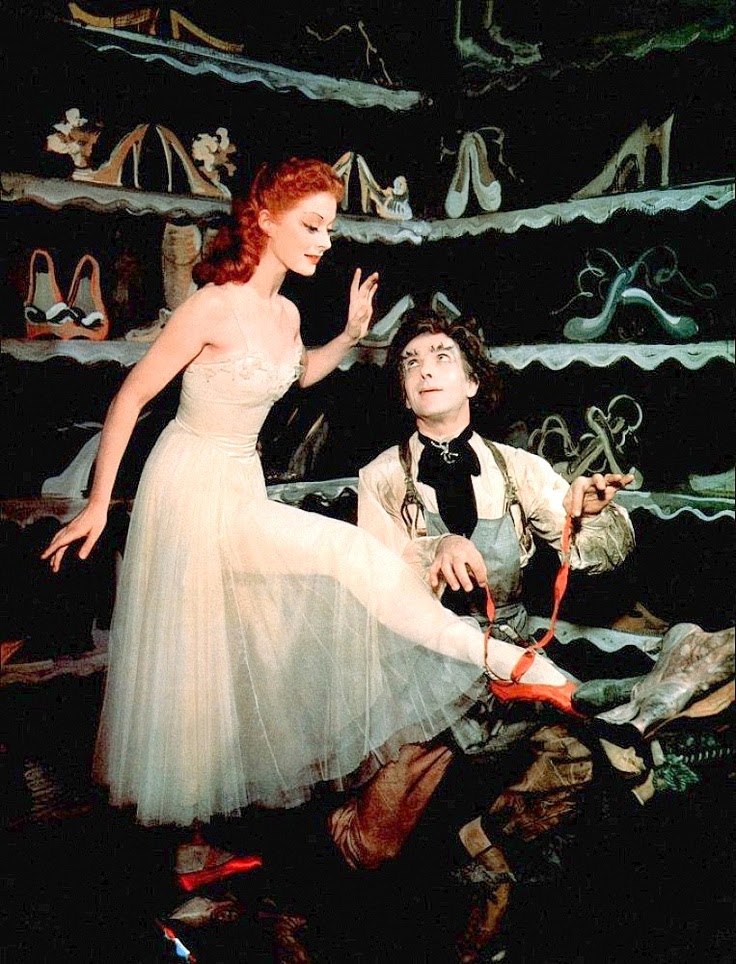
'The Red Shoes' holds up as a compelling piece of cinema

The Red Shoes
Director Martin Scorsese is always name dropping films a mile-a-minute, but there's no film he name-checks (in my estimation) more than Michael Powell and Emeric Pressburger's 1948 ballet drama The Red Shoes.

After finally getting around to seeing this beautifully shot film I can totally understand why.

On the surface level the film is a virtuoso visual delight -- the color, choreography and beauty of the images burst off the screen. It's easy to see why it inspired stylists like Scorsese and Brian De Palma.

The plot is also fascinating. The film deals with the struggle between an individual's art/craft and their personal life. This conflict frustrates the film's characters and ultimately leads to tragedy.

At first it took me a little while to settle into this 1948 film's charms. It's stately British tone and pacing, along with it's, at least on the surface, cliched backstage drama didn't initially enthrall me. But I found myself drawn in, especially by the nominal villain of the piece -- the ballet director played by the excellent Anton Walbrook. His presence, his line readings, even the way he is shot is striking.

And then, right in the middle of the film, comes an extraordinary wordless dance sequence that turns surreal. The second half then takes on a much darker tone and it becomes a story about the obsession of creative drive.

Anton Walbrook and Moira Shearer in The Red Shoes
This may not interest or appeal to everyone -- but it did to me. I myself have grappled with juggling practical vs. emotional passions and needs. I've often  had a hard time reconciling my true interests with what I supposedly "need" to be interested in.

In a way this very blog is an attempt on my part to thread the needle -- I want more than anything to write exclusively about film -- and yet it's not something I can afford to do or have an opportunity to do. So when I can steal a moment for myself I indulge my true passions here.

This film struck a special chord for me. It sort of has a little of everything I love. And yes, that includes beautiful women and the color red (my personal favorite). It is an uncompromising vision which remarkably doesn't adhere to the conventions of its extremely censored age.

I've always appreciated ballet -- although I'm far from an expert on it. But even if you're not interested in dance don't let that deter you from seeing this magical film (and see it on bluray if you can) because the dance could just as easily be replaced with sports or writing or filmmaking or anything that requires skill and determination.

If you are a sucker for old movies that have a lot going on under the surface this is great one to check out. When it ended I found myself in awe. And I couldn't wait to watch again -- this time with the commentary.